
SACHIYO ITO’S MEMOIR: POSTSCRIPT
The final installment of Sachiyo Ito’s inspiring memoir
Since January 2024 renowned dancer, dance educator, and choreographer Sachiyo Ito has been serializing her memoir on JapanCulture•NYC with monthly installments, each chapter revealing a different aspect of her early life in Tokyo and career in New York City.
Ito offers of a profound exploration of the experience of dedicating herself to traditional Japanese dance at an early age, arriving in New York City during the tumultuous ‘70s, and making a successful career in the arts. Each chapter offers a glimpse into the complexities that shaped her journey. It is a literary examination of not only Ito Sensei’s life, but of how New York City’s culture evolved over the decades and what sacrifices one must make to achieve a thriving career in the arts.
The memoir is an invitation to delve into the layers of a creative life and career that has spanned more than 50 years. As a work in progress, it is also an invitation for you to offer your feedback. Your insights will contribute to the evolution of this extraordinary work.
To read all the chapters, please click here. For more information about Sachiyo Ito, please visit her website, dancejapan.com.
Postscript
Looking back at the path I have walked, I feel it as swift as an arrow.
My desire and mission to share the exquisite art of Japanese dance with the world beyond Japan propelled me forward, even as I remained keenly aware of my own artistic limitations. I pressed on with sincerity and devotion, placing the highest value on authenticity. However, I always knew my mission was bold, and at times I felt I should plead with my mentors in Japan to forgive my imperfections. The journey was never easy, especially without financial support or government backing. Upholding the authenticity of Kabuki dance with its centuries-old traditions, costumes, and production values, was nearly impossible without resources.
During the last 50 years, drawing from my classical training, I began to seek out universal themes all the while continuing to use Japanese dance idioms and movements as my source of inspiration. Dance of Crane, which premiered at our 25th anniversary concert in 1997, was deeply rooted in Japanese aesthetics. In contrast, Dream in the program explored a theme that transcended the tradition. Since the 1990s, I have found inspiration in the teachings and poetry of Thich Nhat Hanh and began creating dances based on poetry. Poetry in Motion 1991, performed at Lincoln Center’s Clark Studio and Joyce SoHo, was the beginning of works inspired by Chieko-sho, Thich Nhat Hanh, and Rumi, Nelda, Mary Oliver, using their words as the springboard for my choreography.
In the 2000s, finally my lifelong desire and quest to create my own Dojoji dance resurfaced. After years of research through Kagura and classical tales, I created the Dojoji Series, including Dojoji 2001 and Dojoji 2002.*
Community work with senior centers, geriatric facilities, and public schools in New York City revealed the importance of grassroots engagement. This shaped my work between 2010 and the 2020s. Salon Series, launched earlier in 1998, was also a series of grassroots programs informing about the arts and culture of Japan, and it served as a forum for dialogue between artists and audiences. Collaborations across disciplines and cultures enriched my artistic growth in ways I could never have imagined: Many choreographies were born from these encounters. The program reached its 74th Salon Series in December 2022, and with three final anniversary programs, I brought it to a close.
After an incredible journey of 53 years in the United States, I am grateful to have arrived safely. I bow first to my mother, then to all who supported my work—my company members who stood by me through the years and my students. I feel deeply fortunate to have encountered each person along the way, for they have taught me the preciousness of life.
I mentioned the word Kawara Kojiki (Riverbank Beggar) in the preface and Chapter 9. Though it has long been used as a derogatory term for performers, I never minded being called one. Okuni, who founded Kabuki, was among those labeled Kawara Kojiki, and I understood the undeniable importance of their role in shaping Japanese performing arts history. Many great poets, monks, and performers—Basho, Saigyo—were lifelong travelers. They found the truth of life in the journey itself. I, too, am honored to stand humbly in the lineage of the Kawara Kojiki, wandering artists whose roots lie in movement: Tokyo, New York, Dublin, San Diego, the Rocky Mountains, Montevideo...
As I wrote earlier, wherever we go, we encounter hardship and conflict. There is unarguably damage, brutality, tragedies and ferocity on earth brought on by famine, war, or natural disasters, but in human situations, how we respond determines our happiness. Often, the greatest hurdle is us. But we are also the ones who can transform adversity into something meaningful. There were dark, painful, even life-threatening moments in my journey, but those hardships shaped my art. I believe each of us holds the power to rise like a phoenix in the one life we are given.
I remember a high school class where my teacher wrote on the blackboard, “There is an infinite future in front of you.”
We were 17. Most of us nodded. Those were the days of deep discussions among us, youth, not to speak of other generations—about socialism, democracy, existentialism, about society, and about ourselves. What could I contribute as an individual? Even that question felt selfish, in the truest sense.
In writing this memoir, I began to realize that it is not just a record of travels and performances, but rather a quest of self. It became a reflection on life, identity, and on what it means to be a dancer, a Japanese, an immigrant, and a small human being whose mother’s voice still calls “Sachiyo-chan” like a child. She always ended her letters with “Do not catch cold.”
Though I have no children, I say the same to my friends and students. There is always someone who cares about you—a mother, father, aunt, or even the trees, flowers, blue sky, and clouds in unimaginable shapes. If you look closely, they are always smiling at you. Nature is a miracle. Enjoy its beauty and the gifts it offers.
Thank you for the privilege of expressing my thoughts through my memoir, and for reading.
With a deep bow,
Sachiyo Ito
YouTube Cliop: Autumn Season from Slow Dance in Four Seasons in New York
“Let everything happen to you, beauty and terror.
Just keep going.
No feeling is final.”
*Dojoji legend, which first began as a Buddhist tale, has prevailed since the 10th century. It created the genre “Dojoji-mono” in literature and folk performing arts such as Kagura, Noh and Kabuki.
Kyoganoko Musume Dojoji, originally staged in 1752, is the most iconic Kabuki dance of the genre. Therefore, I felt it necessary to perform it in introducing Kabuki dance in my U.S. debut at the American Dance Festival in 1972, as well as on several occasions during my career in the US.
One high point of this 4th annual celebration was the odori (classical and folk dancing) exquisitely performed by Sachiyo Ito and Company. In an all too brief program, Ms. Ito revealed a technical virtuosity and an amazing range of styles, moods and characters that was a delightful glimpse into the heart and soul of Japanese dance.
Like the delicate cherry blossoms that fade all too soon, the unforgettable work of Sachiyo Ito and Company came to an end as the applause died out and the lights dimmed for the final time. All that was left was a barren stage to remind us that art, life and beauty are to be fully enjoyed in the present moment before being released to eternity.
— Gerri Igarashi Yoshida
NY NICHIBEI - May 23, 1985
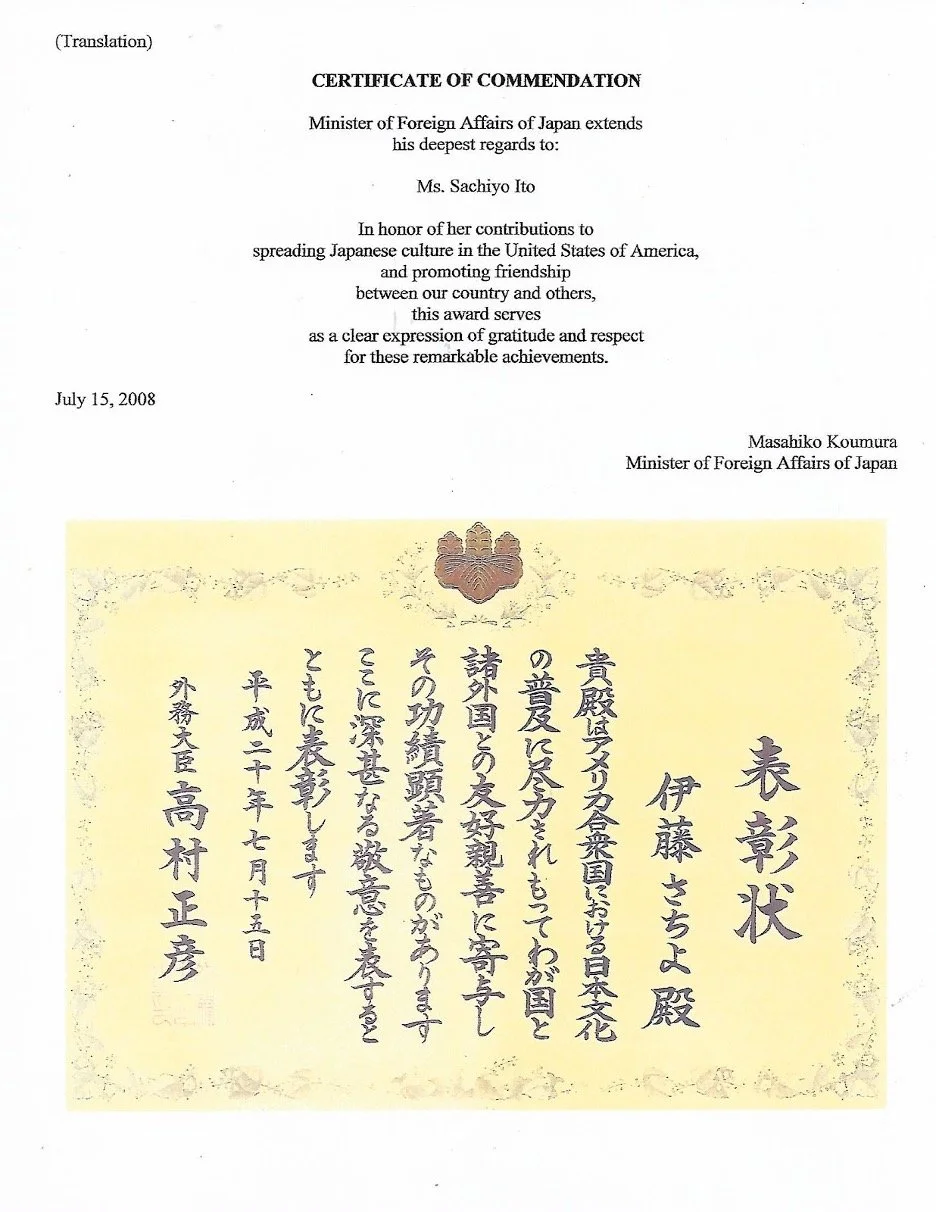
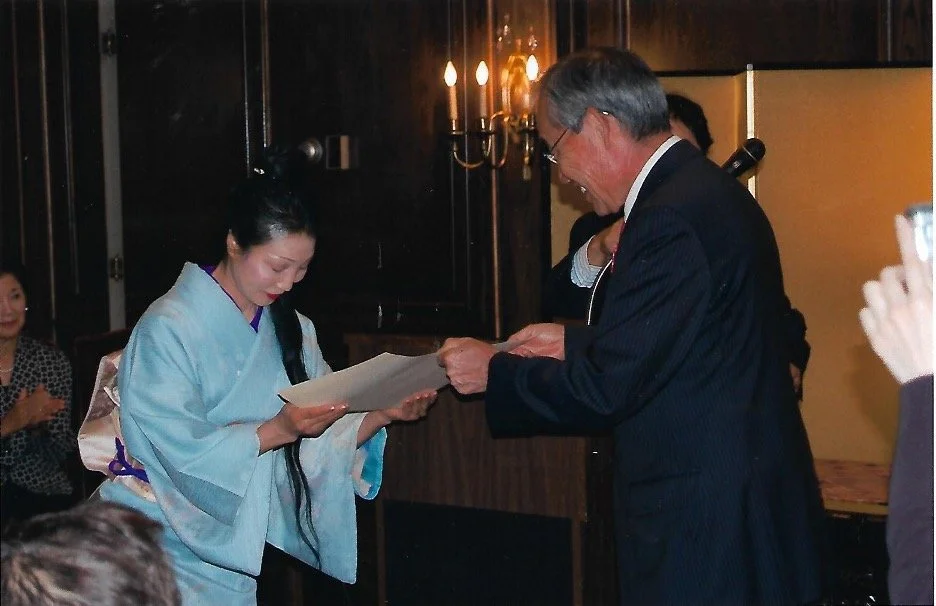
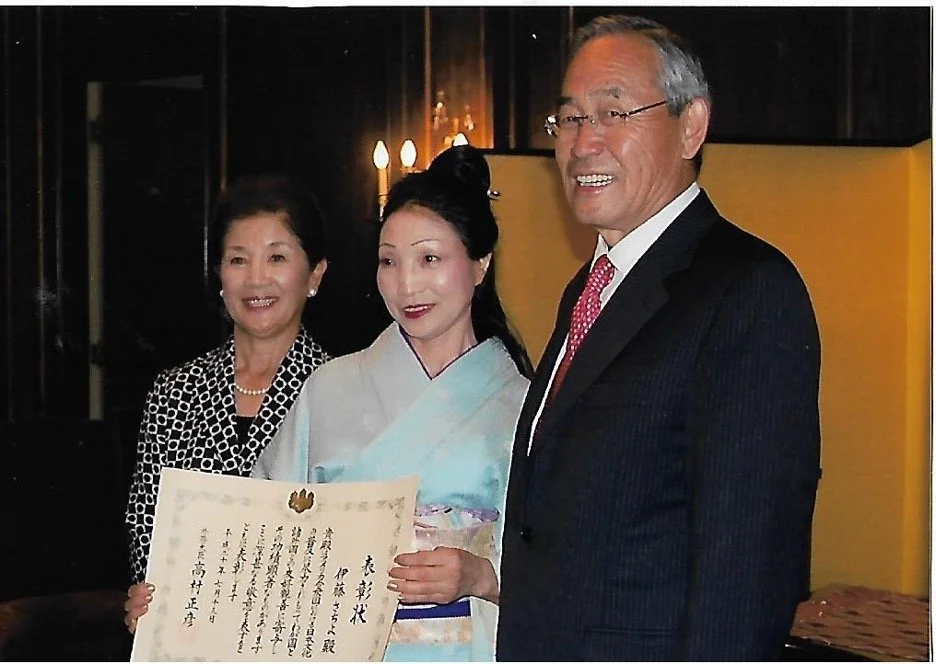
Sachiyo Ito’s Certificate of Commendation from the government of Japan
The posting of this chapter to JapanCulture-NYC.com was paid for by Sachiyo Ito and reprinted here with her permission. Susan Miyagi McCormac of JapanCultureNYC, LLC edited this chapter for grammatical purposes only and did not write or fact-check any information. For more information about Sachiyo Ito and Company, please visit dancejapan.com. ©Sachiyo Ito. All rights reserved.
Support JapanCulture•NYC by becoming a member! For $5 a month, you’ll help maintain the high quality of our site while we continue to showcase and promote the activities of our vibrant community. Please click here to begin your membership today!