

Course on Artists of Japanese Ancestry
Joseph Tokumasu Field, an art historian and educator, has developed CrossCurrents, an exciting new course that is centered around twentieth-century artists of Japanese ancestry.
CrossCurrents
Mondays from October 13, 2025 through November 3, 2025 from 7:00 p.m. until 8:30 p.m. EDT
Virtually on Zoom
Admission: $80
Joseph Tokumasu Field, an art historian and educator, has developed CrossCurrents, an exciting new course that is centered around twentieth-century artists of Japanese ancestry.
Meeting on four consecutive Monday evenings beginning October 13 through November 3, Field and attendees will deep dive into the inspiring lives and work of the selected artists: Toshiko Takaezu, Atsuko Tanaka, Miné Okubo, and Henry Sugimoto. Using the newest scholarship, this course celebrates the important contributions to visual art, design, education, and political activism of these Japanese and Japanese American luminaries.
With an emphasis on lively discussions and shared discovery, the class will occur online through Zoom and will be recorded for participants to view/review in their own time. The cost is $80, which includes the four classes along with a further reading list, class schedule, weblinks, and other provided materials. Registrants who mention JapanCulture•NYC will receive a 25% discount, bringing the total to $60! Scholarships and other accommodations are available upon request.
To register and for more information, please contact Field at joetokumasufield@gmail.com.
Course Schedule
Toshiko Takaezu
Week 01 – Monday, October 13 from 7:00 p.m. until 8:30 p.m. ET
Featured Artist: Toshiko Takaezu
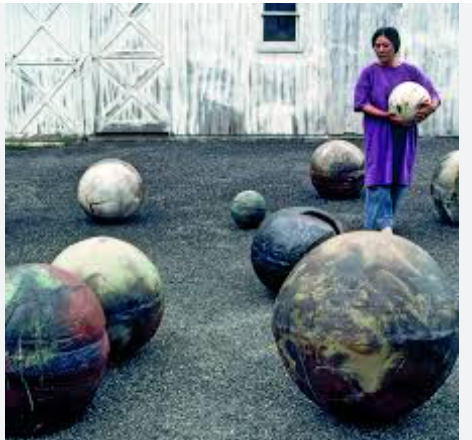
American artist Toshiko Takaezu (1922–2011) was born in Pepeekeo, Hawaii, to Japanese immigrant parents Shinsa and Kama Takaezu. One of eleven children, she was raised in a traditional Japanese household whose values, as well as the surrounding Hawaiian landscape, strongly underscore her artistic practice. During her five-decade-long career, the artist worked in many media including painting, fiber, and bronze. However, her primary medium, and that for which she is best recognized, was ceramics. Takaezu was instrumental in the post-war reconceptualization of ceramics from the functional craft tradition to the realm of fine art. Her signature “closed form” merged the base form with glazed surface painting to create a unified work. From the Toshiko Takaezu Foundation
Atsuko Tanaka
Week 02 – Monday, October 20 from 7:00 p.m. until 8:30 p.m. ET
Featured Artist: Atsuko Tanaka
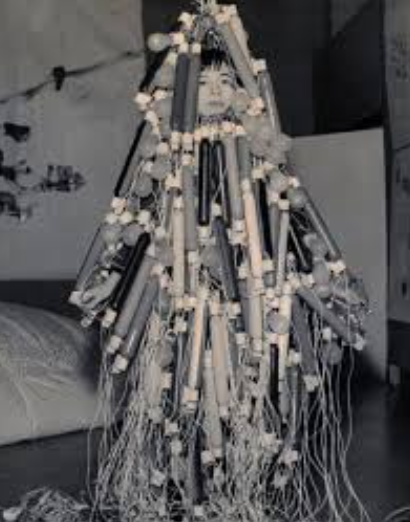
Born in Osaka, Japan, Atsuko Tanaka (1932-2005) was an innovative artist whose work gained prominence among the flourishing postwar Japanese avant-garde. Interested in understanding the relationship between the body, space, and time, her works challenged traditional notions of art and performance. While a member of the groundbreaking Gutai group, Tanaka created Electric Dress (1956), a garment made from 200 colorful blinking light bulbs which the artist wore in performance. From the 1960s onward, Tanaka produced mainly abstract paintings with colorful compositions at once organic and ordered. From Glenstone

Miné Okubo
Week 03 – Monday, October 27 from 7:00 p.m. until 8:30 p.m. ET
Featured Artist: Miné Okubo
Miné Okubo (1912-2001) remains best known as a narrator and artist of the Japanese American camp experience, most famously in her 1946 book, Citizen 13660, a graphic memoir of her confinement at Tanforan and Topaz. However, Okubo considered herself first and foremost a painter, and she devoted seven decades to perfecting her art. Her work is currently on view at Pennsylvania Academy of the Fine Arts (PAFA) in the exhibition Pictures of Belonging: Miki Hayakawa, Hisako Hibi, and Miné Okubo through January 4, 2026. From Densho

Henry Sugimoto
Week 04 – Monday, November 3 from 7:00 p.m. until 8:30 p.m. ET
Featured Artist: Henry Sugimoto
Henry Sugimoto (1900–1990), a Japanese-born artist who studied in Los Angeles and France, achieved largely posthumous fame for his paintings documenting the official wartime confinement of Japanese Americans by the U.S. government. Sugimoto lived and worked in New York City, and his works are held in many major institutions/collections. From Densho
Support JapanCulture•NYC by becoming a member! For $5 a month, you’ll help maintain the high quality of our site while we continue to showcase and promote the activities of our vibrant community. Please click here to begin your membership today!

Miné Okubo’s Portraits at SEIZAN Gallery NYC
Miné Okubo, Untitled, 1940s from SEIZAN Gallery
Miné Okubo: Portraits
Now through Saturday, March 1
SEIZAN Gallery – 525 W. 26th Street (between 10th and 11th Avenues), Ground Floor
Admission: Free
SEIZAN Gallery is presenting Miné Okubo: Portraits, the gallery's first solo exhibition featuring work by one of the most influential Japanese American artists of the 20th Century. Until March 1, 2025, works by Okubo will be on public display, some for the first time, including eleven portraits completed in the late 1940s. Okubo achieved early success as an artist and continued to be extraordinarily prolific throughout her life until her death in 2001. She is most renowned for Citizen 13660, a groundbreaking memoir that combines visual art and narrative to record her experience living in Japanese American internment camps during World War II.
About Miné Okubo
Born in Riverside, California, in 1912, Miné Okubo was a nisei, or second-generation Japanese American. After earning an MFA in art and anthropology from the University of California, Berkeley, she was awarded the prestigious Bertha Taussig Fellowship to study in Paris under Fernand Léger. When World War II broke out, Okubo returned to the United States in 1939 on the last ship from Europe. Back in California, she contributed to mural projects under the Federal Art Project and curated exhibitions.
From 1942 to 1944, Okubo was detained at the Tanforan Relocation Center in San Bruno, California, and at the Topaz Internment Camp in Utah. While in these camps, she created more than 2,000 drawings using charcoal, watercolor, pen, and ink. During this time she taught art to others in the incarcerated population, alongside Chiura Obata and other notable artists. Published in 1946, Citizen 13660 includes nearly 200 illustrations documenting daily life in the camps. It received the American Book Award in 1984.
Miné Okubo, Untitled, 1940s from SEIZAN Gallery
Life and Work in New York City
After her release from Topaz in 1944, Okubo relocated to New York City, where she went on to have a successful career as a commercial illustrator for prestigious publications such as The New York Times, LIFE, and Fortune while continuing her painting practice. Her debut assignment was illustrating the magazine's April 1944 "Japan" issue. Portraits—especially of women and children—remained a central focus of her work. In "Personal Statement" she wrote "From the beginning, my work has been rooted in a concern for the humanities."
The eleven portraits featured in this exhibition were created in the late 1940s, just a few years after Okubo’s release from the camps. These bold, powerful works share stylistic connections with her earlier charcoal drawings from the internment period, which are also displayed in the gallery. While her camp drawings often convey the despair and trauma of the incarcerated, the later portraits—rendered in colorful pastel—capture energy, strength, and compassion. The anonymous figures exude vitality and humanity, celebrating everyday life and signal an early transition to Okubo's iconic, color-rich style.
Recognition and Legacy
Her contributions have been recognized in numerous ways. In 1965, CBS-TV featured her in the documentary Nisei: The Pride and the Shame. In 1972, her first retrospective was held at the Oakland Museum. In 1981, Okubo testified before the Commission on Wartime Relocation and Internment of Civilians (CWRIC), advocating for the inclusion of internment history in educational curricula.
Okubo’s works are now archived at the Center for Social Justice & Civil Liberties at Riverside Community College District and featured in prominent museum collections, including the Smithsonian American Art Museum, the Japanese American National Museum, and the Oakland Museum. Her legacy endures in exhibitions like The View from Within curated by Karin Higa in 1992 at the Japanese American National Museum as well as on-going group exhibition Pictures of Belonging: Miki Hayakawa, Hisako Hibi, and Miné Okubo at the Smithsonian American Art Museum curated by ShiPu Wang through August 17, 2025.
SEIZAN Gallery
Located in Chelsea, SEIZAN’s hours are Tuesday through Saturday from 11:00 a.m. until 6:00 p.m. and Sunday and Monday by appointment. For more information, please visit SEIZAN Gallery’s website.
Support JapanCulture•NYC by becoming a member! For $5 a month, you’ll help maintain the high quality of our site while we continue to showcase and promote the activities of our vibrant community. Please click here to begin your membership today!
Restaurant Nippon hosts a special fugu kaiseki