
Japan Village to Host Setsubun Party
Japan Village hosts event to celebrate Japanese tradition of welcoming good luck
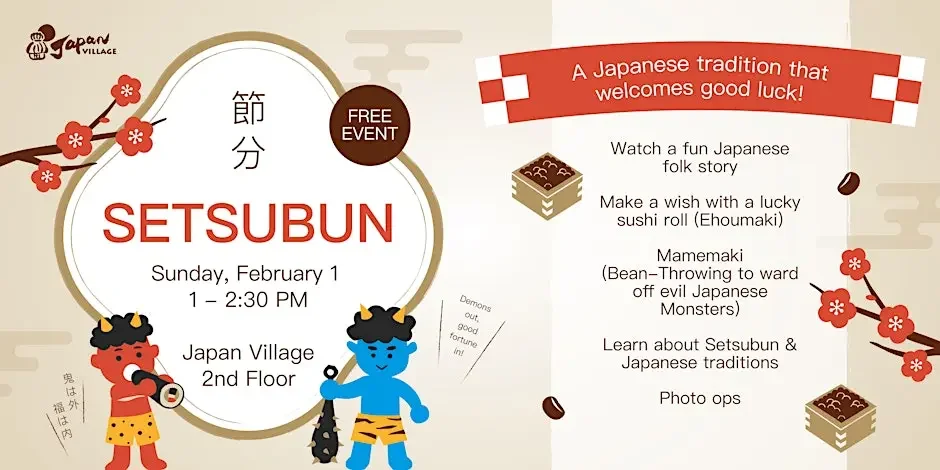
Setsubun
Sunday, February 1 from 1:00 p.m. until 2:30 p.m.
Japan Village – 934 3rd Avenue, Brooklyn | 2nd Floor LOFT
Admission: Free
Head to Japan Village for an afternoon of cultural performances and hands-on traditions celebrating Setsubun, the Japanese tradition of celebrating the birth of spring. Guests can enjoy music, stories, and hands-on traditions.
WHAT TO EXPECT
Japanese folk story
Live shamisen performance
Eho-maki demo
Mamemaki bean-throwing to ward off evil Japanese oni (monsters)
Photo ops
Tasty treats
To reserve your spot for this family-friendly cultural event, please visit Japan Village’s Eventbrite page.
Enjoy JapanCulture•NYC? This site is supported by our community, and a $5/month membership helps offset the costs of keeping it running—so we can continue spotlighting the people and events that make our community shine. Please click here to join.
Setsubun Tradition at Wasan Brooklyn
Wasan Brooklyn’s Eho-Maki Week
Wasan Brooklyn’s Eho-Maki Week
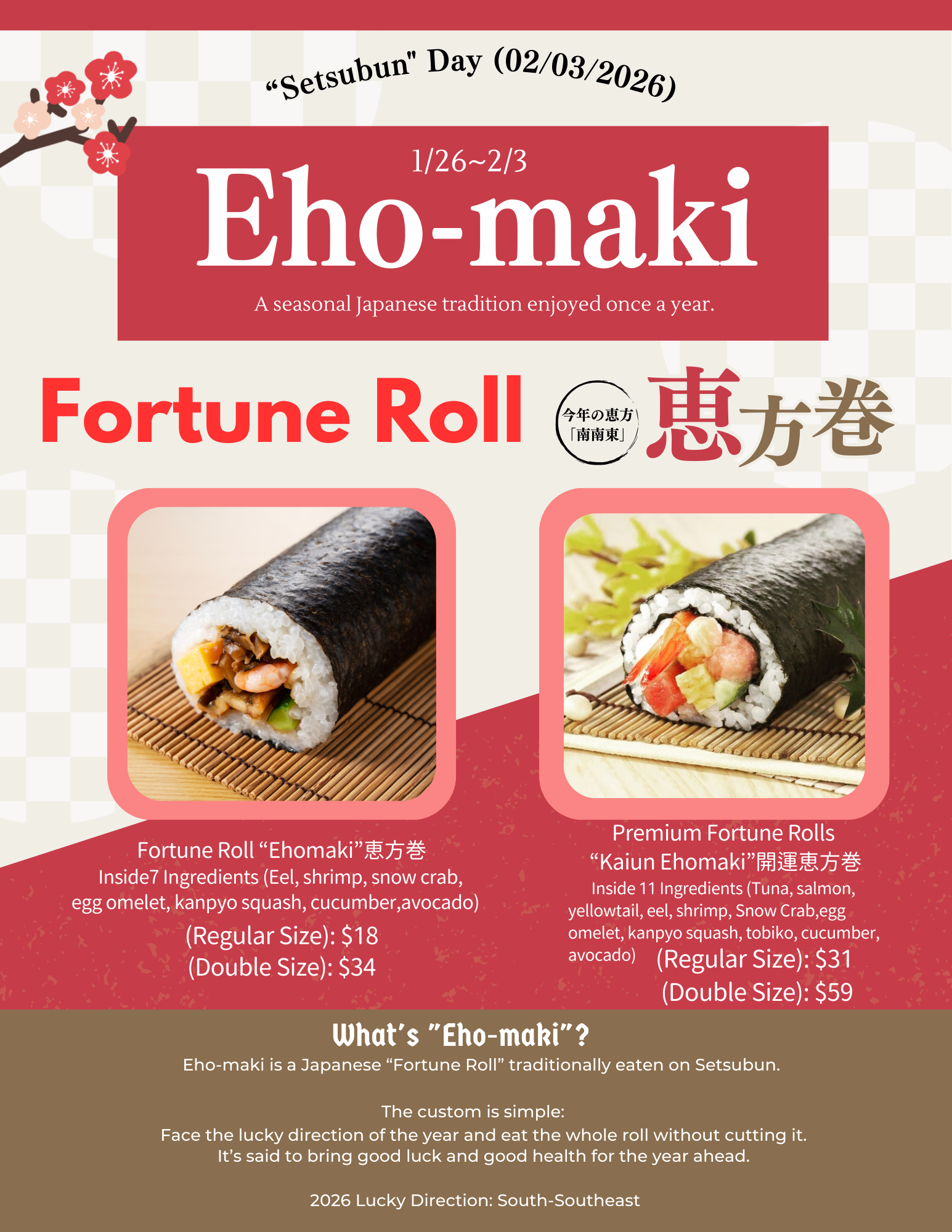
Now through Tuesday, February 3, 2026
Wasan Brooklyn – 440 Bergen Street, Brooklyn
Cost: $18-$59
For one day each winter, silence at the dinner table is encouraged and while facing in a specific direction. Setsubun, a seasonal turning point observed on February 3, is closely tied to food rituals meant to invite good health and prosperity for the year ahead. In New York, those traditions now extend well beyond the home.
Wasan Brooklyn is celebrating this tradition by offering two kinds of eho-maki now through February 3, the day Setsubun is observed. The restaurant is located at 440 Bergen Street, Brooklyn, NY 11217 and is open daily from 11:30 a.m. until 9:15 p.m.
Fortune Roll Eho-Maki with Seven Ingredients
Eel, shrimp, snow crab, egg omelet, kanpyo squash, cucumber, avocado
Regular size: $18
Double size: $34
Kaiun Eho-Maki (Premium) with Eleven Ingredients
Tuna, salmon, yellowtail, eel, shrimp, snow crab, egg omelet, kanpyo squash, tobiko, cucumber, avocado
Regular size: $31
Double size: $59
Rules for Eating Eho-Maki
Eho-maki literally means “lucky direction rolls,” and of course, there are rules to maximize the luck you’re sure to receive once you’ve consumed them.
Eat the entire roll without cutting it
Face the lucky direction of the year (south-southeast for 2026)
Eat in silence
For more information or to place an order, please visit Wasan Brooklyn’s website.
Enjoy JapanCulture•NYC? This site is supported by our community, and a $5/month membership helps offset the costs of keeping it running—so we can continue spotlighting the people and events that make our community shine. Please click here to join.
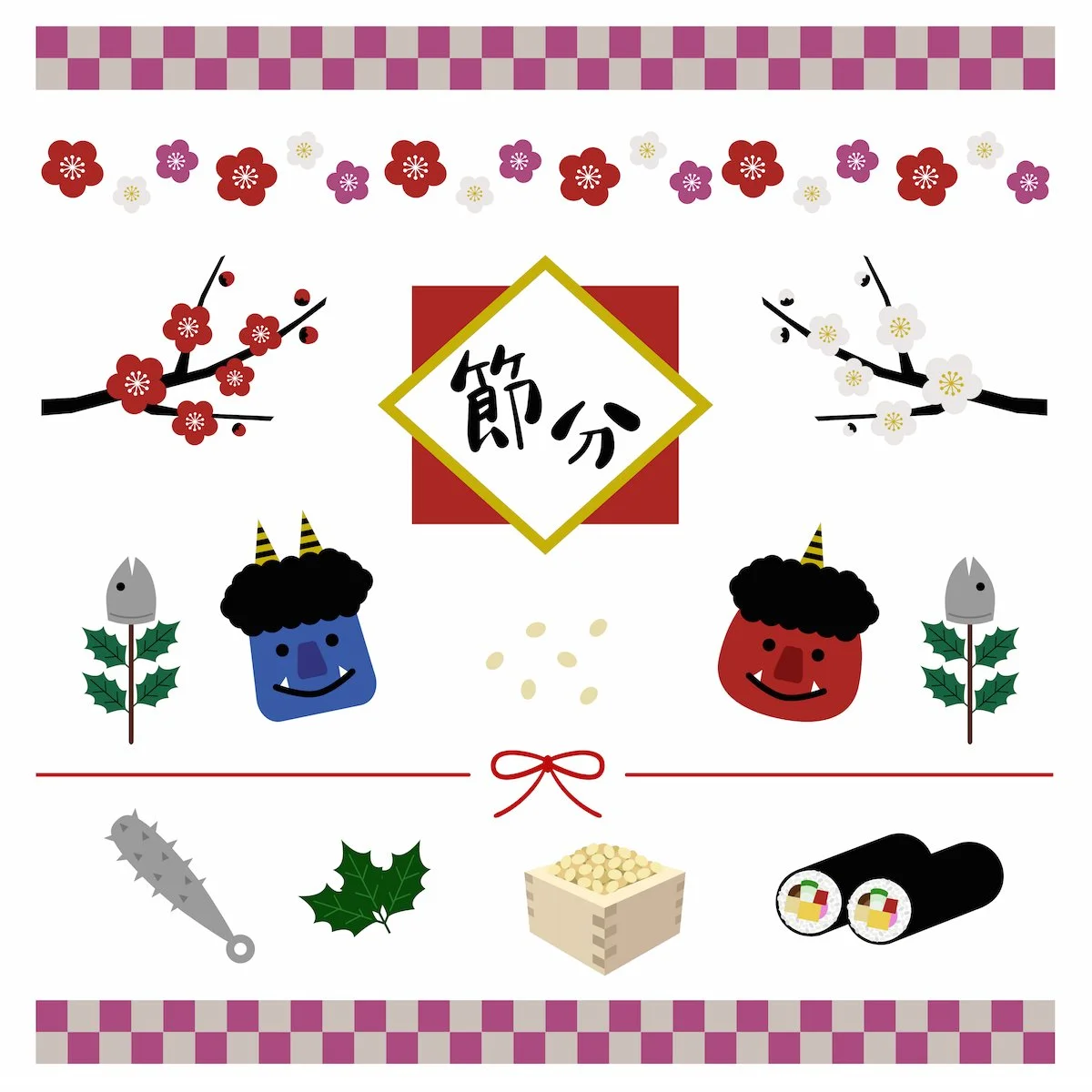
Celebrating Setsubun in NYC
Setsubun and where to find it in NYC
Winter may still have a firm grip on New York, but in Japan the calendar is already shifting. Setsubun marks the quiet threshold between seasons: a moment to reset, brush off lingering misfortune, and prepare for the year ahead. Observed on February 3, the tradition blends ritual, food, and community in ways that feel especially resonant during the coldest stretch of the year.
What is Setsubun?
Literally meaning “season division,” Setsubun falls on the day before spring, at least according to the Lunar calendar. The change is marked with rituals that drive out evil spirits, known as oni, by throwing roasted soybeans (fukumame) and yelling “Oni wa soto! Fuku wa uchi!” (“Demons out! Fortune in!”)
After dispersing the soybeans, it’s customary to count out the number of beans that corresponds to your age—called toshinokazu—and eat them for good luck and good health. Food plays an equally symbolic role in the celebration, particularly ehomaki, thick sushi rolls with fillings that represent good health, prosperity, and happiness.
In New York, these traditions now extend beyond the home, with restaurants and community spaces offering their own ways to observe Setsubun.
Now through Tuesday, February 3
Wasan Brooklyn
440 Bergen Street, Brooklyn
Japanese restaurant Wasan Brooklyn is observing Setsubun with two types of eho-maki. Place your order at the restaurant’s website or visit in person.
Sunday, February 1
Japan Village
934 3rd Avenue, Brooklyn | 2nd Floor LOFT
1:00 p.m. until 2:30 p.m.
Admission: Free
Head to Japan Village for an afternoon of cultural performances and hands-on traditions celebrating Setsubun. Guests can enjoy music, stories, and hands-on traditions. Learn more at Japan Village’s website.
You can also purchase eho-maki at Obentoyasan in the Japan Village food court on February 1 and February 3.
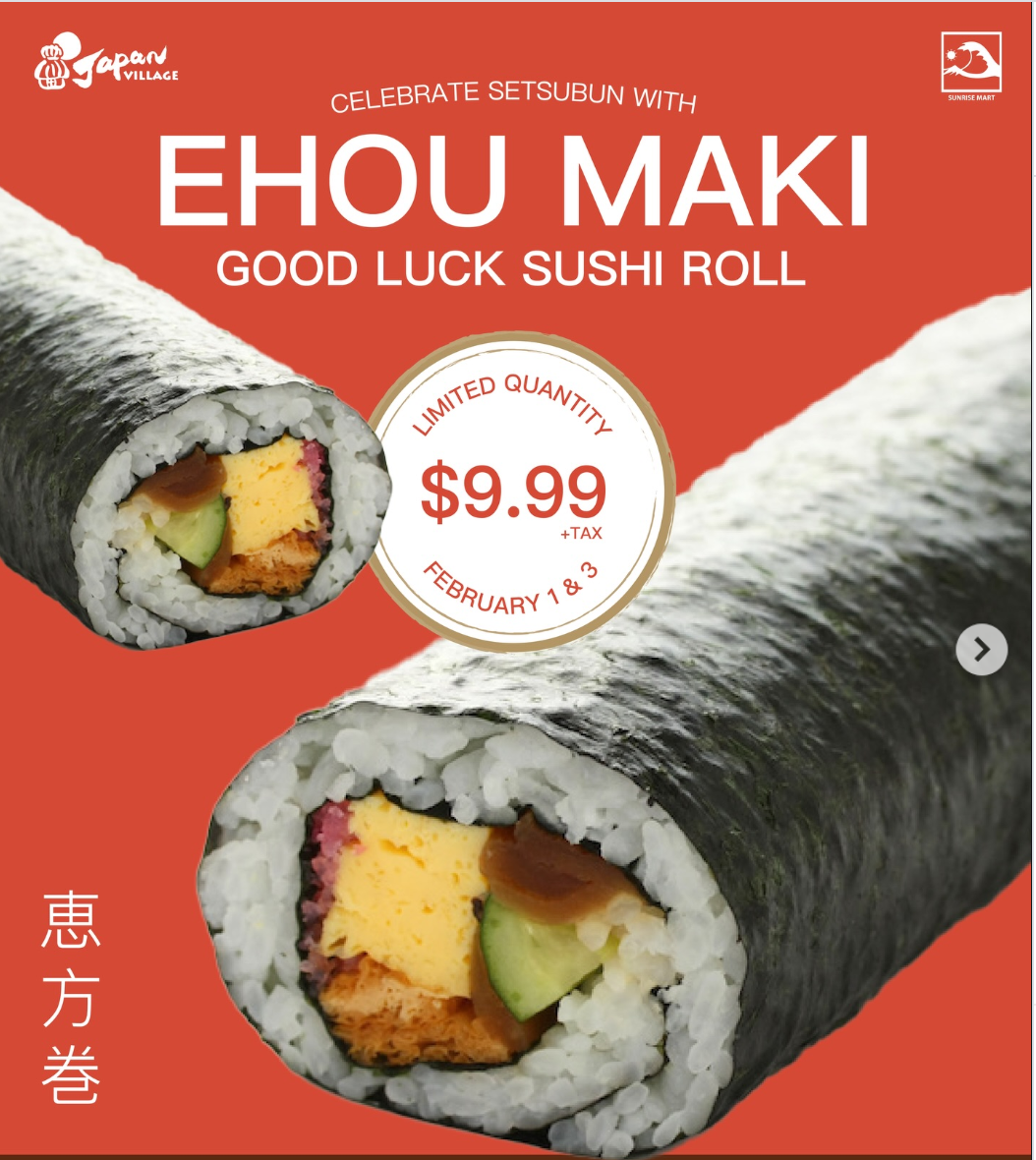
Tuesday, February 3
Izakaya Mew
53 W. 35th Street, Basement
Only on Setsubun, Izakaya Mew will offer their substantial eho-maki in person or delivery. Check out their Instagram post with the details.
Lunch: Noon until 2:15 p.m.
Dinner: 5:00 p.m. until 9:30 p.m.Sunrise Mart
SoHo: 494 Broome Street | 11:00 a.m. until 8:00 p.m.
Midtown: 12 E. 41st Street | 10:00 a.m. until 8:00 p.m.
The Manhattan locations of this popular Japanese grocery store will sell eho-maki on February 3 only.
In whatever way it’s observed, Setsubun is a reminder that the new season has already begun—even if winter hasn’t quite gotten the message yet.
Enjoy JapanCulture•NYC? This site is supported by our community, and a $5/month membership helps offset the costs of keeping it running—so we can continue spotlighting the people and events that make our community shine. Please click here to join.

Tea Ceremony Celebrating Hina Matsuri
Join tea ceremony master Yoshitsugu Nagano for a Hina Matsuri Tea Gathering featuring a rare Kinin-date ceremony. This special tea gathering celebrates the seasonal beauty, grace, and Japanese tradition of Hina Matsuri, Japan’s Doll Festival.
NY Seasonal Tea Ceremony: Hina Doll's Tea Ceremony
Saturday, March 29 from 10:30 a.m. until Noon and 2:00 p.m. until 3:30 p.m. (Two Sessions)
Globus Tea Room – 889 Broadway PHC at E. 19th Street
Admission: $100
Join tea ceremony master Yoshitsugu Nagano for a Hina Matsuri Tea Gathering featuring a rare Kinin-date ceremony. This special tea gathering celebrates the seasonal beauty, grace, and Japanese tradition of Hina Matsuri, Japan’s Doll Festival.
What is Hina Matsuri?
Observed annually on March 3, Hina Matsuri is a cherished tradition in Japan, celebrating the health, happiness, and prosperity of young women. At the heart of this festival are the exquisite Hina dolls, elegant figures representing members of the imperial court from the Heian period (794-1185), a golden age of art, poetry, and refined court culture.
In honor of this graceful tradition, Nagano will present a tea ceremony featuring the Kinin-date style of tea preparation: a rare and formal ritual once reserved for noble guests of the court.
What to Expect
A serene and elegant tea ceremony demonstration
The opportunity to drink freshly prepared matcha
A beautifully arranged kaiseki-style Japanese meal, reflecting the seasonal flavors of spring
An immersive atmosphere inspired by the refined beauty of the imperial court
As you enjoy both matcha and traditional Japanese cuisine, you will be invited into a world of timeless elegance, echoing the spirit of Murasaki Shikibu and Sei Shonagon, iconic female writers who helped shape Japan’s artistic heritage.
To register, please visit Nagano’s Eventbrite page and select the session you would like to attend.

Matcha. Photo courtesy Yoshitsugu Nagano.
About the Tea Master
Yoshitsugu Nagano is the youngest person to be certified in the highest rank of the Ueda Soukata school of samurai tea ceremony, which has been practiced in Hiroshima for four hundred years. He serves as a professor at the school.
In 2019, Nagano relocated to New York City, where he energetically promotes the spirituality and aesthetics of the Japanese tea ritual, rooted in Zen, through tea rituals and classes. He has also been working on and establishing new styles of modern tea ceremony that incorporate new expressions to create new ways of engaging with the traditional ritual.
Dress Code
Western-style clothes are acceptable, but please do not wear sleeveless shirts or short skirts. Bring a clean pair of white socks. Organizers will ask you to remove jewelry and watches.
Support JapanCulture•NYC by becoming a member! For $5 a month, you’ll help maintain the high quality of our site while we continue to showcase and promote the activities of our vibrant community. Please click here to begin your membership today!

Explore The Sacred World of Sumo
Explore the sacred world of sumo at The Public Theater
SUMO
Now through Sunday, March 30
The Public Theater – 425 Lafayette Street (at Astor Place)
Admission: $93* | $65* Side seats | $73 Public Supporters and Partners
The New York premiere of SUMO by Lisa Sanaye Dring is running now through March 30. A co-production of Ma-Yi Theater Company and La Jolla Playhouse, SUMO is directed by Obie Award winner Ralph B. Peña.
About the Play
Step into the sacred world of sumo wrestling with Dring’s mesmerizing new drama. Entrenched in an elite sumo training facility in Tokyo, six men practice, eat, love, play, and ultimately fight. Akio arrives as an angry, ambitious 18-year-old with a lot to learn. Expecting validation, dominance, and fame, and desperate to move up the ranks, he slams headlong into his fellow wrestlers. With sponsorship money at stake, their bodies on the line, and their futures at risk, the wrestlers struggle to carve themselves—and one another—into the men they dream of being. SUMO is a thrilling new play set in an elite and rarely explored world. This powerhouse drama features live taiko drumming by Shih-Wei Wu.
For performance times and to purchase tickets, please visit The Public Theater’s website. The listed ticket prices include a $10 per ticket service fee. The fee is waived for Public Theater Supporters & Partners and when purchasing at the Taub Box Office.

SUMO. Photo: Joan Marcus
Support JapanCulture•NYC by becoming a member! For $5 a month, you’ll help maintain the high quality of our site while we continue to showcase and promote the activities of our vibrant community. Please click here to begin your membership today!

Wasan Osechi Box 2025
As the end of the year approaches, it’s time to place your order for osechi ryori, the traditional Japanese New Year meal. Brooklyn-based Japanese restaurant Wasan is accepting orders for their Wasan Osechi Box 2025. The restaurant has been sharing this cultural experience with the community for more than a decade now.
The boxes are available for pick up or delivery to select locations in Manhattan, Queens, Brooklyn, and New Jersey. Prices range from $295 to $330 plus tax.

Highlights of Wasan’s Osechi Offerings
丹波の黒豆 (Tanba no Kuromame: Black Soybeans): Directly sourced from Osaka, Wasan’s owner-chef’s hometown. These carefully prepared beans are a customer favorite for their perfectly sweet and tender flavor.
栗きんとん (Kuri Kinton: Sweet Chestnuts): Naturally colored with gardenia flowers, their kinton has no artificial additives and offers a beautifully golden and health-conscious sweetness.
伊達巻 (Datemaki: Shrimp-Filled Egg Roll): By adding shrimp, they create a fluffy, light texture and a rich, balanced flavor.
Extra Special Exclusive Promotions
10% Off for December 31 Pick-Up: Everyone who picks up their orders on New Year’s Eve will receive a 10% discount. Plus, you’ll enjoy Wasan’s special toshikoshi soba, which is typically eaten on December 31, for the perfect transition to the New Year.
Sashimi Takeout Set for Two - $48: A fresh assortment of tuna, salmon, and other favorites.
Wasan Junmai Ginjo - $29: Normally $58, this exclusive offer is available for December 31 only. Pair it with your Osechi for an exceptional celebration.
Customers’ Rave Reviews
“It was incredible to enjoy authentic Osechi in New York!”
“Our entire family was delighted—Wasan’s Osechi made our New Year so special.”
“This was the best goma-mame I’ve ever had. I look forward to it every year!”
“Just wanted to say the Osechi was delicious. Honestly, it was perfect.”
Quantities are limited, so place your order now. For more details and to place your order, please visit Order Wasan Osechi 2025.
Support JapanCulture•NYC by becoming a member! For $5 a month, you’ll help maintain the high quality of our site while we continue to showcase and promote the activities of our vibrant community. Please click here to begin your membership today!

DIY Matcha Workshop at a-un Brooklyn
Nina Tea Salon “Matcha Tea DIY Workshop”
Sunday, January 21 at 12:30 p.m.
Sunday, February 11 at 12:30 p.m. and 1:30 p.m.
Sunday, February 25 at 12:30 p.m. and 1:30 p.m.
a-un Brooklyn — 156 Knickerbocker Avenue, Brooklyn
Admission: $35 plus tax
Welcome to Nina Tea Salon 2024
Nina Tea Salon presents a “Matcha Tea DIY Workshop” at a-un Brooklyn, a Japanese restaurant by the owner/chefs of Wasan Brooklyn. Using the finest premium matcha imported directly from Japan, Nina Tea Salon invites you to enjoy the beauty of authentic Japanese culture. Be enchanted by the harmonious pairing of this exquisite tea with handmade, seasonally inspired traditional desserts.
In these 30-minute sessions, Nina will guide participants on how to make a bowl of light matcha tea at home for yourself and your loved ones!
Three Levels of Learning
Level 1 — Preparation and tea-whisking technique
Level 2 — Purifying utensils
Level 3 — Combined techniques of Levels 1 and 2
The serene ambiance, the lingering aroma of freshly whisked matcha, the symphony of flavors, and the atmosphere both tradition and innovation will surely captivate your senses.
Seating is limited, so register by using this Google Form.
About A-un
The phrase "a-un no kokyuu," literally translating to the "breath of a-un," originates from an ancient Japanese idiom. This expression signifies a silent communication between two individuals who understand each other without the need for words.
Sake sommelier Toshi Koizumi and chef Kakusaburo Sakurai opened Wasan East Village in 2010 and Wasan Brooklyn in Park Slope, Brooklyn, five years later. Together they opened a-un Brooklyn last year. Over the years, as restaurant owners, they have found their a-un, strongly reaffirming the sheer joy and importance of serving the local community through their cuisine.

TEA CEREMONY DEMOS AT THE MET
Tea Ceremony Demonstrations
Tuesday, September 26 at 11:30 a.m. and 1:30 p.m.
The Metropolitan Museum of Art – 1000 Fifth Avenue
Free with Museum Admission
Instructors from the Urasenke Chanoyu Center will demonstrate a traditional Japanese Tea Ceremony. There will be two sessions, one at 11:30 a.m. and one at 1:30 p.m. Each session will last one hour.
The demonstrations will take place in Gallery 209, The Astor Forecourt. For more information, please visit The Met’s website.

Set of Utensils for the Tea Ceremony, Kubo Shunman 窪俊満 (Japanese, 1757–1820)
Image: Kubo Shunman (1757–1820), Set of Utensils for the Tea Ceremony, Japan, Edo period (1615–1868), 1810s. Woodblock print (surimono); ink and color on paper. H. O. Havemeyer Collection, Bequest of Mrs. H. O. Havemeyer, 1929 (JP1974)
“Surimono” is a style of woodblock print that were produced in small quantities and particularly for private commissions. In this elegant still-life surimono by writer and artist Kubo Shunman, New Year’s tea ceremony utensils are arrayed with a branch of camellia, a flower associated with the end of winter and beginning of spring according to the lunar calendar.
Translation of the Poem on the Woodblock Print
At a tea gathering
on the day spring arrives:
Sipping auspicious tea
made with New Year’s water,
the tea ceremony begins—
as spring arrives before
the official start of the year.
— Kokin no Nakanari
(translated by John T. Carpenter, Mary Griggs Burke Curator of Japanese Art in the Department of Asian Art at The Metropolitan Museum of Art)
Support JapanCulture•NYC by becoming a member! For $5 a month, you’ll help maintain the high quality of our site while we continue to showcase and promote the activities of our vibrant community. Please click here to begin your membership today!
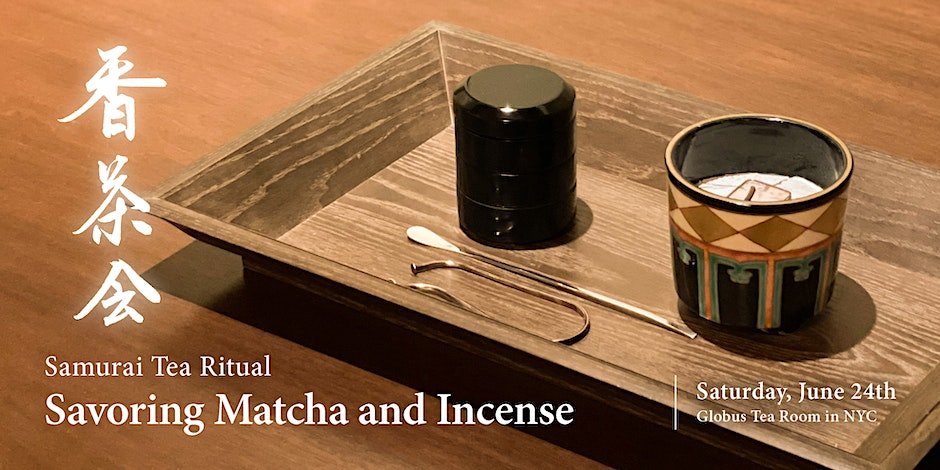
Experience Incense with Tea Ceremony
Samurai Tea Ceremony: Savoring Matcha and Incense
Saturday, June 24
Morning Session from 10:30 a.m. until noon
Afternoon Session from 2:00 p.m. until 3:30 p.m.
Globus Washitsu – 889 Broadway at E. 19th Street, PHC
Admission: $108.55
The world of tea ceremony is deep and full of various pleasures. In addition to drinking matcha together, people also enjoy flowers and incense together.
June, known as the rainy season, is Japan's wettest month before summer begins in earnest. While the high humidity makes it more comfortable to spend time indoors during this season, it has long been considered the best time to burn incense.
Although it is not practiced much anymore, there is a ritual in the world of the tea ceremony called kōshomō. In this ceremony, incense burned by the first guest is passed around and enjoyed by all participants. After the incense has calmed the mind, a cup of matcha tea becomes even more special. The Samurai Tea Ceremony will offer two types of incense.
In addition, Nagoshi Tofu will be served. It is a traditional Japanese custom to eat Nagoshi Tofu in June, when half of the year is over, to purge the impurities of the previous half year and to pray for good health for the remaining half year.
To register, please visit tea master Yoshitsugu Nagano’s Eventbrite page and select the session you would like to attend.

Yoshitsugu Nagano (far right) performs a tea ceremony at Globus Washitsu
About the Tea Master
Yoshitsugu Nagano is the youngest person to be certified in the highest rank of the Ueda Soukata school of samurai tea ceremony, which has been practiced in Hiroshima for four hundred years. He serves as a professor at the school.
In 2019, Nagano relocated to New York City, where he energetically promotes the spirituality and aesthetics of the Japanese tea ritual, rooted in Zen, through tea rituals and classes. He has also been working on and establishing new styles of modern tea ceremony that incorporate new expressions to create new ways of engaging with the traditional ritual.

Tea ceremony implements by Yoshitsugu Nagano
About the Japanese Tea Ritual
The ritual of Japanese tea has an 800-year history. Samurai warriors developed the tea ceremony as their essential practice to relax and preserve their mental health after battles. In addition to performing a tea ceremony, Nagano will also discuss Japanese history, culture, and most important, the relationship between samurai warriors and tea ceremony.
Globus Washitsu, the setting for the event, is a tatami-mat oasis with traditional Japanese architecture. Says Nagano, “You won’t find better place than this place to experience Japanese culture.”
Dress Code
Western-style clothes are acceptable, but please do not wear sleeveless shirts or short miniskirts. Bring a clean pair of white socks. Organizers will ask you to remove jewelry and watches.
For All Things Japanese in New York City, become a member of JapanCulture-NYC.com
and follow @JapanCultureNYC on Instagram, Twitter, and Facebook!
JAPAN SOCIETY’S KODOMO NO HI
Children's Day: Kodomo no Hi
Sunday, May 7
Session 1: 10:30 a.m. until 12:30 p.m.
Session 2: 1:00 p.m. until 3:00 p.m.
Japan Society – 333 E. 47th Street (between 1st and 2nd Avenues)
Admission: $15 | $10 Japan Society members | Free children ages 2 and under and Cool Culture members
Carp streamers flying can only mean one thing: Children’s Day is here!
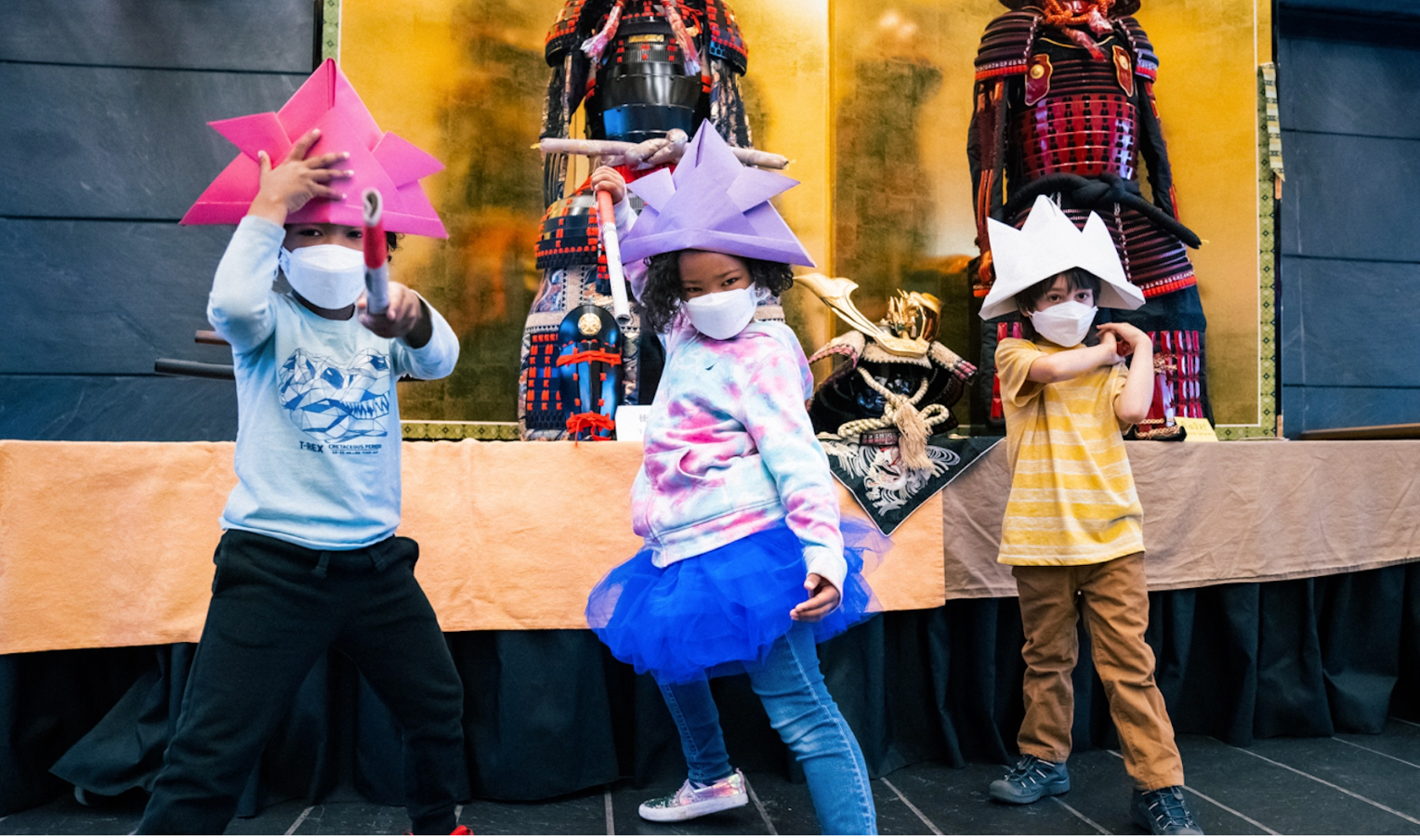
Share the joy of childhood as Japan Society celebrates Japan’s national holiday packed with fun for the whole family. Every child is a star as they pose with life-sized samurai armor displays and take to the stage in a popular sword-fighting workshop led by Kyo Kasumi from TATE Hatoryu NY. Families will also be captivated by the beauty of traditional Japanese dance through an enchanting performance by Sachiyo Ito & Company.
Image © Ayumi Sakamoto
Children can design their own koinobori carp streamer and wearable origami kabuto helmet. The excitement doesn’t end when you leave: There will be take-home craft kits for you to continue the fun at home!
For more information and to register, please visit Japan Society’s website.
Looking to deepen your understanding and appreciation of Japanese culture? Look no further than JapanCulture•NYC's membership program!
As a member, you'll gain access to exclusive content about events, workshops, and resources that will immerse you in the fascinating world of Japanese art, cuisine, history, and more. Whether you're a seasoned Japanophile or just beginning to explore this rich cultural tradition, our membership program offers something for everyone. From crafting classes to kimono-wearing workshops, from sake tastings to film screenings, you'll discover new facets of Japanese culture and connect with like-minded individuals who share your passion.
So why wait? Sign up for our membership program today!
Japan Village’s annual Summer Festival is a free Japanese event that brings together nearly 8,000 attendees for a day of food, games, and cultural performances.