

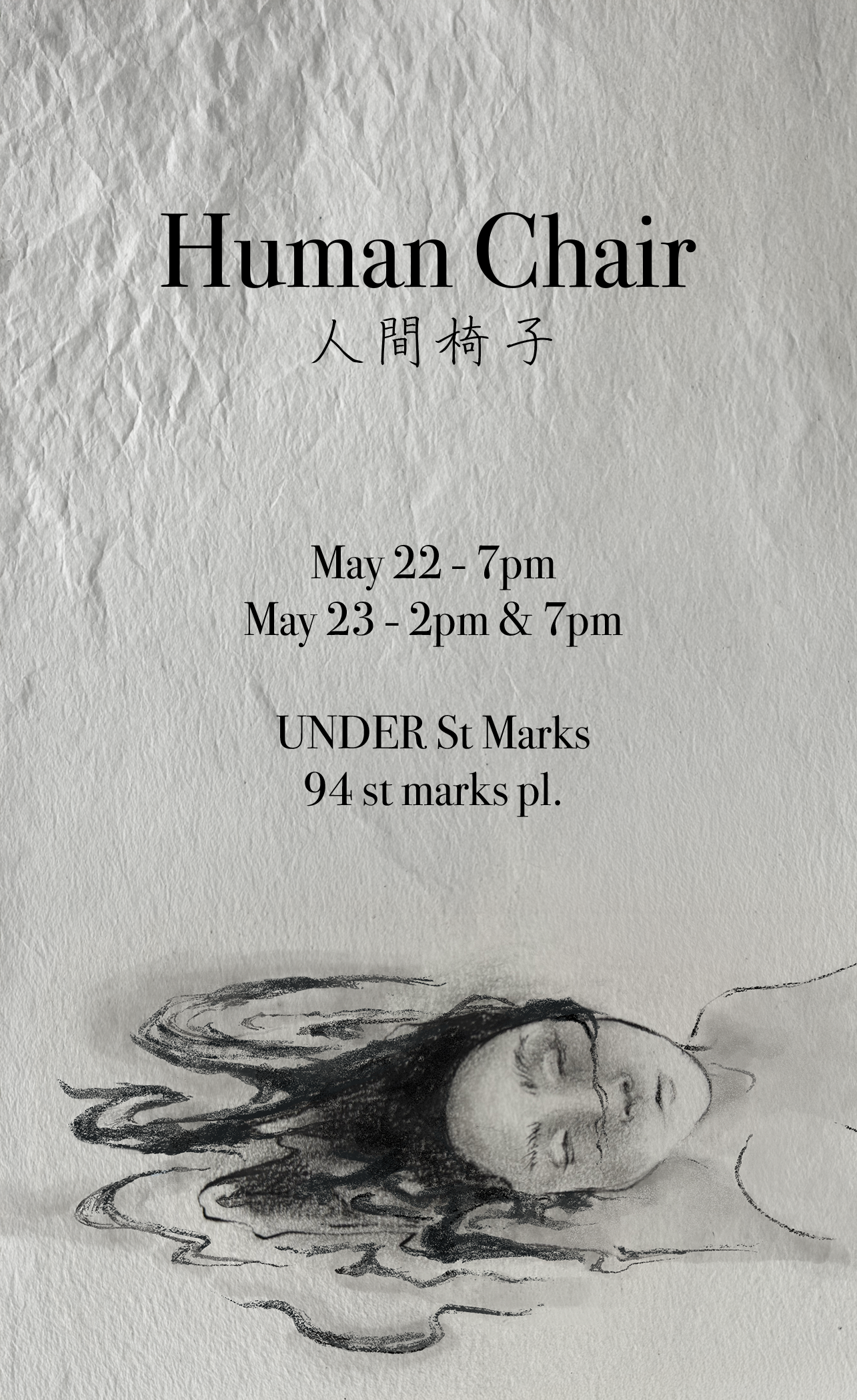
Adaptation of Edogawa Rampo’s HUMAN CHAIR
What does it mean to be utterly consumed by longing for another?
HUMAN CHAIR
Friday, May 22 at 7:00 p.m.
Saturday, May 23 at 2:00 p.m. and 7:00 p.m.
UNDER St. Marks – 94 St. Marks Place (between 1st Avenue and Avenue A)
Admission: $20 (plus $2.50 fee)
Illustration by @zoroze.art
What does it mean to be utterly consumed by longing for another? In this unsettling dance-theatre work, performed by Yusuke Mori and Zo Roze, a craftsman's obsession takes a form both intimate and grotesque: He sews himself inside the furniture of the woman he desires.
Adapted from the classic story by Edogawa Rampo, Japan's master of the macabre whose pen name is itself a winking tribute to his idol Edgar Allan Poe, HUMAN CHAIR transforms the story's dark, suffocating premise into something visceral and physical.
Performed in Japanese with English subtitles. Runtime is 80 minutes. For more information and to purchase tickets, please visit Frigid New York’s website.
Enjoying JapanCulture•NYC? This site is supported by our community, and a $5/month membership helps offset the costs of keeping it running so we can continue spotlighting the people and events that make our community shine. Please click here to join.
Japan Society Presents Dance Production Based on Mishima
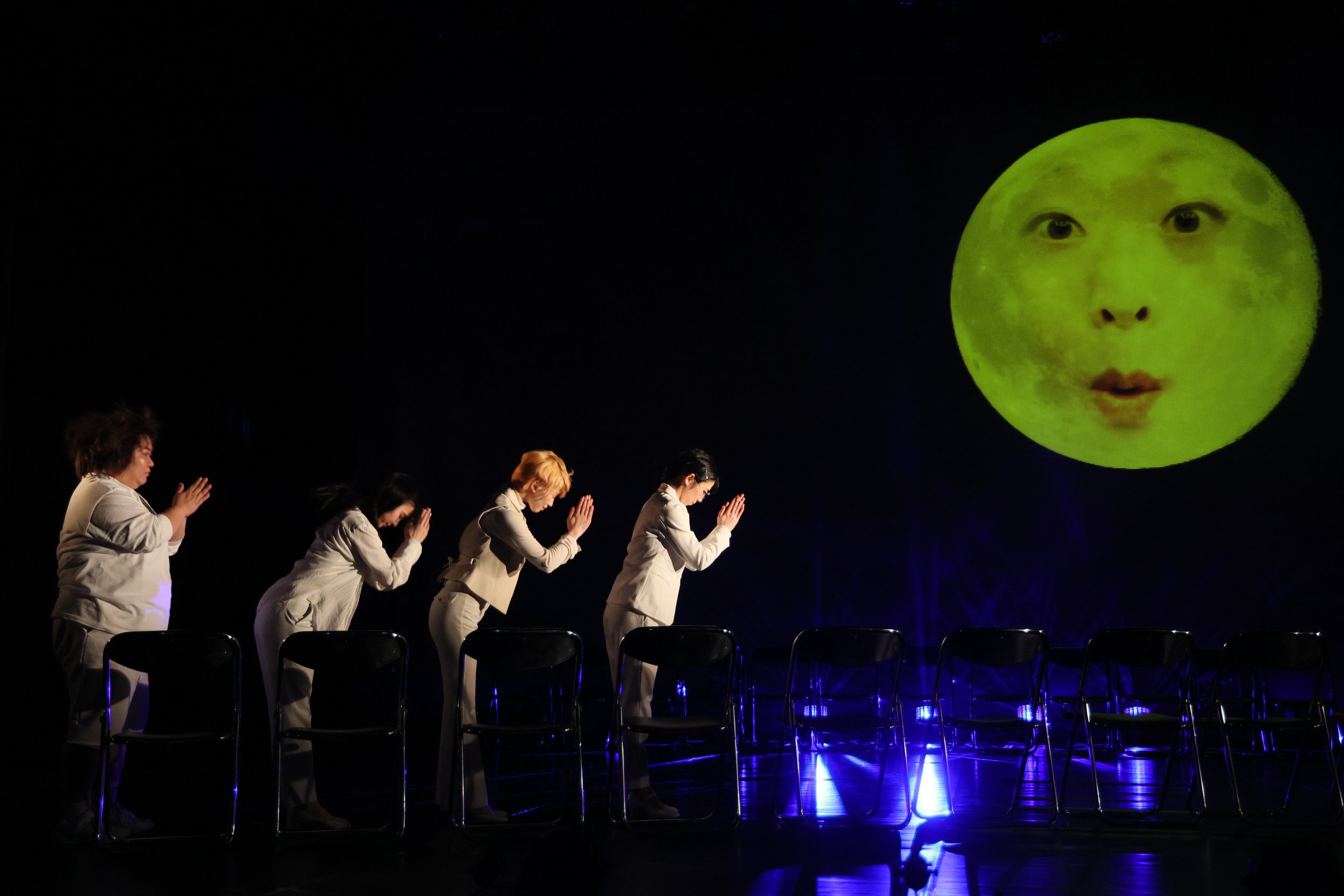
Japan Society’s Fall 2025 Yukio Mishima Centennial Series: Emergences continues with the world premiere dance production of The Seven Bridges (Hashi-zukushi). A vibrant new work for all ages from the Tokyo-based dance company CHAiroiPLIN with choreography by company founder Takuro Suzuki is based on a lesser-known short story of the same title by Yukio Mishima.
The Seven Bridges
Saturday, November 15 at 7:30 p.m.
Sunday, November 16 at 2:30 p.m. — Followed by an Artist Q&A
Japan Society – 333 E. 47th Street (between 1st and 2nd Avenues)
Admission: $48 | $36 Japan Society members
Japan Society’s Fall 2025 Yukio Mishima Centennial Series: Emergences continues with the world premiere dance production of The Seven Bridges (Hashi-zukushi). A vibrant new work for all ages from the Tokyo-based dance company CHAiroiPLIN with choreography by company founder Takuro Suzuki is based on a lesser-known short story of the same title by Yukio Mishima.
The Seven Bridges. © Photo by HARU
About The Seven Bridges
CHAiroiPLIN (a tongue-in-cheek amalgamation of Charlie Chaplin’s name and the Japanese word chairoi, meaning “brown”) is acclaimed for converting great authors’ novels into disarmingly enchanting yet satirical performances, appropriate for all ages, told almost entirely through movement. In this work, founder and choreographer Takuro Suzuki and company take on Yukio Mishima’s suspenseful and humorous short story. Following a fanciful superstition that crossing seven bridges without conversing with anyone on a full moon night will make their wishes come true, four women occupying different positions of wealth and societal status set out on a journey under the watchful gaze of the Moon. As distractions and mishaps befall the women, their race to the end of the seventh bridge becomes increasingly fraught—who, if anyone, will be able to make it to the end, and for what kind of wish? With spirited, arresting and slapstick movement set to an impressive range of high-energy music encompassing Daft Punk, Balkan brass band Fanfare Ciocărlia, eccentric original songs performed live, and more, Suzuki and CHAiroiPLIN infuse unbridled charm into Mishima’s compact reflection on ritual and desire.
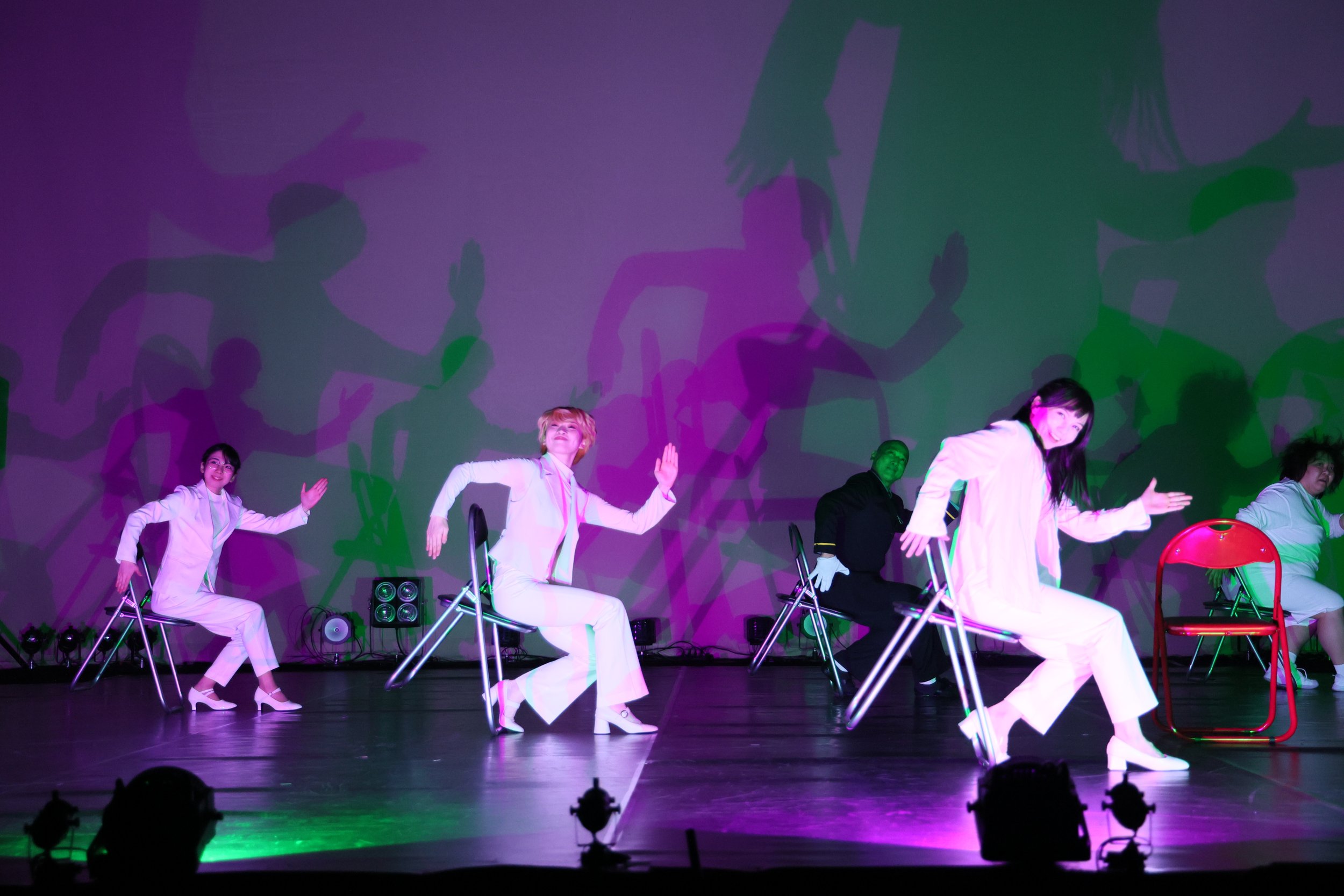
The Seven Bridges. © Photo by HARU
Yukio Mishima’s short story “The Seven Bridges” was originally published in Japan in 1956. Two years later, Mishima himself developed this story into a dance drama. While CHAiroiPLIN’s entirely original work reflects their own signature gleefully absurdist style, the company has deliberately adapted a narrative which Mishima himself envisioned as uniquely appropriate for the dance stage.
This program is presented by Japan Society as part of Carnegie Hall’s Spotlight on Japan. Recommended for ages 7+. Performance runs approximately 55 minutes. To purchase tickets, please visit Japan Society’s website. Ticketholders will also receive complimentary, same-day admission for one person to Chiharu Shiota: Two Home Countries, on view at Japan Society Gallery through January 11, 2026. To view the exhibition, please show ticket/receipt to the Welcome Desk for free admission before the performance.
About CHAiroiPLIN
CHAiroiPLIN is a Tokyo-based dance company founded by the dancer/choreographer Takuro Suzuki. Made up of a combination of theater performers and dancers, the company incorporates an expressive variety of forms fusing dance, dialogue, singing, onomatopoeia, and other creative elements. They aim to create highly entertaining and narrative-driven dance performances that can be enjoyed by audiences of all ages.
Since its establishment in 2007, CHAiroiPLIN has received numerous awards for its ongoing “Dancing Literature” series, which adapts modern and classical Japanese literature and plays ranging from novels to manga, rakugo (traditional comedic storytelling) and folktales, utilizing idiosyncratic and stylized body movements and expert choreography. Some notable productions include Fantasy Stone (based on Shigeru Mizuki’s manga), which was awarded the Audience Prize in the 1st Sengawa Drama Contest; Market, a winner of the NEXTREAM21 Dance Festival All Genre Dance Contest; and Friends (based on an absurdist play by the acclaimed Japanese dramatist Kobo Abe), a winner of the Grand Prize at the Young Directors Competition.

Takuro Suzuki © Courtesy of CHAiroiPLIN
About Takuro Suzuki
Takuro Suzuki was born in Niigata Prefecture in 1985. He studied theater, pantomime, and dance at Toho Gakuen College of Drama and Music, led by world-renowned Japanese director Yukio Ninagawa. After graduating, he continued to present public performances that spotlight new possibilities of combining dance and theater. He aims to create works incorporating a variety of dance, dialogues, singing, and Japanese onomatopoeia that can be enjoyed by children and adults alike.
Suzuki founded the dance company CHAiroiPLIN in 2007 and has been a primary member of the dance company CONDORS since 2011. He choreographs and has appeared in NHK’s hugely popular weekly children’s program Miitsuketa! (“Found it!”) and created choreography for the television programs Touken Ranbu and Bungo Stray Dogs. He is the recipient of numerous awards, including the New Artist Award from the Agency for Cultural Affairs Arts Festival, the Yokohama Dance Collection EX Honorable Mention and was a finalist for the Toyota Choreography Award. In 2015, he was selected as the 2015 Ambassador of Cultural Exchange in East Asia, and he received the New Artist Award in the Dance Division from the Minister of Education, Culture, Sports, Science, and Technology in 2024.
About Yukio Mishima
Born Kimitake Hiraoka, Yukio Mishima (1925-1970) was a Japanese author, poet, playwright, actor, model, Shintoist, ultra-nationalist, and leader of an attempted coup d'état that culminated in his suicide. Mishima is considered one of the most important postwar stylists of the Japanese language. He was nominated for the Nobel Prize in Literature five times in the 1960s. His works include the novels Confessions of a Mask, Life for Sale, and The Sailor Who Fell from Grace with the Sea as well as the plays My Friend Hitler, The Lady Aoi, and Madame de Sade.
To celebrate the 100th anniversary of Mishima’s birth, Japan Society has hosted a compelling roster of new productions and U.S. company premieres throughout the fall. More than half a century since Mishima’s last published work, he continues to inspire artists in the 21st century. Japan Society Artistic Director Yoko Shioya remarks, “This series revitalizes Mishima’s contributions to the world of the arts through a slate of brand-new commissions and premieres adapting his writings, as well as a historic U.S. debut for a revered Noh company. This series not only recognizes Mishima’s critical legacy, but the ongoing current influence of this essential post-war author on artists today.”
The Series launched in September with Yukio Mishima’s KINKAKUJI, a Japan Society world premiere commission adapted for the stage by Leon Ingulsrud and Major Curda from Mishima’s novel Kinkakuji (The Temple of the Golden Pavilion) with scenic design by internationally acclaimed visual artist Chiharu Shiota. The series continued in October with Le Tambour de Soie (The Silk Drum), co-created by Yoshi Oida and Kaori Ito, both headlining artists in France’s performing arts’ scene. This work mixes contemporary dance with exquisite movement adapted from Noh into a dark and seductive piece of dance-theater, based on Mishima’s adaptation on the traditional Japanese Noh classic Aya no Tsuzumi.
Following the world premiere of The Seven Bridges (Hashi-zukushi), the Series culminates with Mishima’s Muse – Noh Theater on December 4 through 6, featuring the momentous U.S. debut of the distinguished Hosho Noh School performing a set of plays which Mishima later adapted, including Aya no Tsuzumi, Aoi no Ue, and the original kyogen (comedic) play Busu, adapted by Mishima into a modern English comedy.
Support JapanCulture•NYC by becoming a member! For $5 a month, you’ll help maintain the high quality of our site while we continue to showcase and promote the activities of our vibrant community. Please click here to begin your membership today!
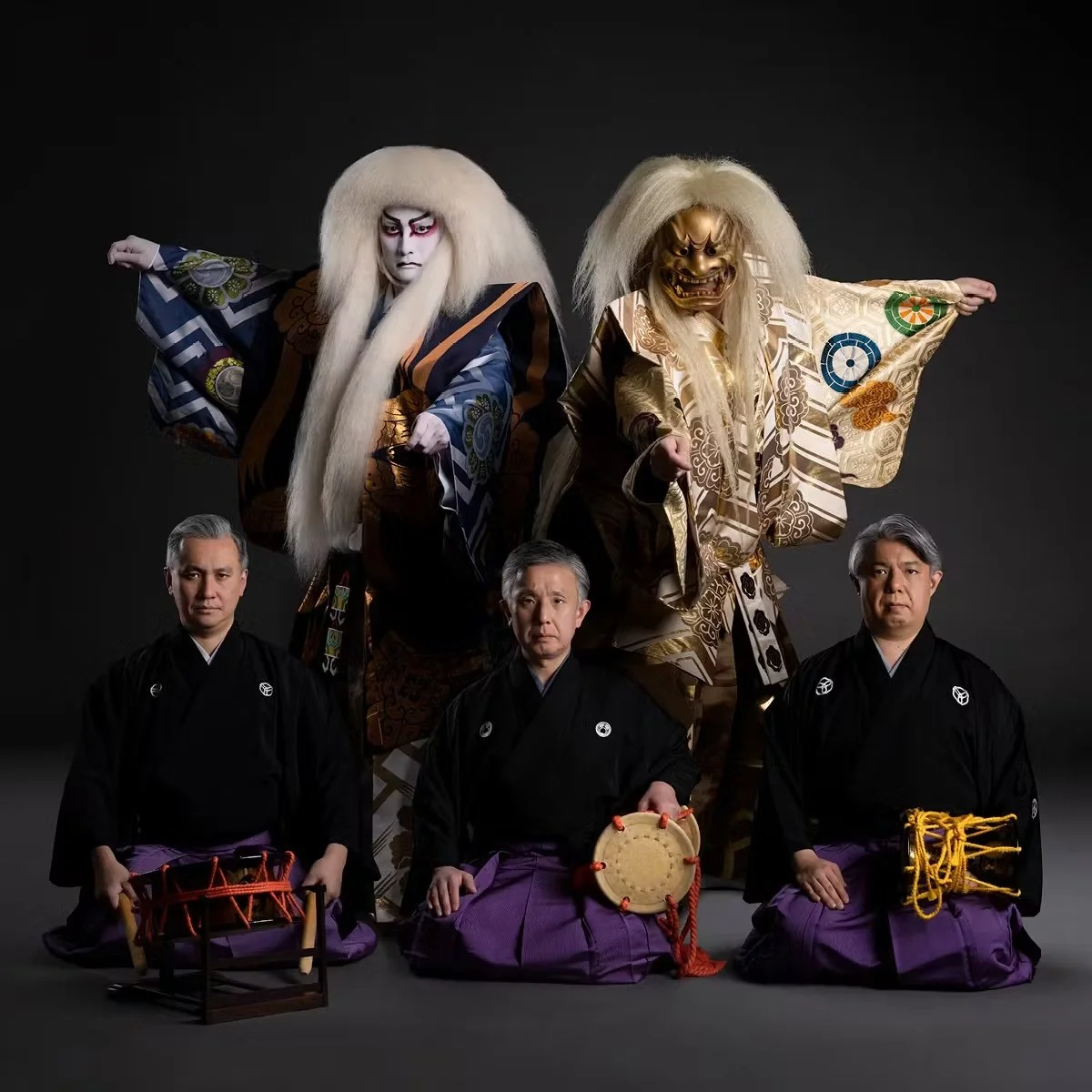
Kabuki, Noh, and More at Carnegie Hall
Discover the heritage and evolution of Noh and Kabuki theater, taiko drumming, the three-stringed shamisen, and more led by today’s foremost actors, musicians, and representatives of art forms that have been handed down and passionately studied for centuries.
An Evening of Traditional Japanese Arts
Friday, November 14 at 8:00 p.m.
Carnegie Hall | Stern Auditorium/Perelman Stage – 57th Street and 7th Avenue
Admission: $86.50 - $226
Carnegie Hall will be the site of a very special performance: An Evening of Traditional Japaense Arts. Discover the heritage and evolution of Noh and Kabuki theater, taiko drumming, the three-stringed shamisen, and more led by today’s foremost actors, musicians, and representatives of art forms that have been handed down and passionately studied for centuries.
Performers
Hirotada Kamei – Noh Musician
Denzaemon Tanaka – Kabuki Musician
Denjiro Tanaka – Kabuki Musician
Yoshimasa Kanze – Noh Actor
Takanobu Sakaguchi – Noh Actor
Saburota Kanze – Noh Actor
Hayato Nakamura – Kabuki Actor
Hiromitsu Agatsuma – Shamisen
Kouki Agatsuma – Shamisen
Masaru Tsuji – Wadaiko
Ryotaro Leo Ikenaga – Wadaiko
Suguha Otani – Japanese Dance
Yumi Kurosawa – Koto
Takuya Iwata – Shakuhachi
Yuichi Otsuki – Noh Actor
Manabu Takeichi – Noh Musician
Wakichi Kineya – Nagauta Singer
Chotatsuro Imafuji – Nagauta Shamisen
Gotaro Kineya – Nagauta Musician
Katsueiji Kineya – Nagauta Musician
Katsukuniharu Kineya – Nagauta Musician
Tatsujuro Imafuji – Nagauta Musician
Kan Fukuhara – Shinobue
The performance will last approximately two and a half hours with one 20-minute intermission. To purchase tickets, please visit Carnegie Hall’s website.
An Evening of Traditional Japanese Arts by Kosuke Yoshino
Sankyokai
Sankyokai (“Three Resonances”) is an ensemble dedicated to exploring new artistic possibilities through the sound of hayashi—the traditional musical accompaniment of Noh and Kabuki—by fusing the resonances of Japan’s two foremost traditional performing arts. Since its founding in 1997, the group has carried forward the spirit of classical performance while continuing to create sounds that transcend time.
The members are three brothers: Hirotada Kamei, head of the Kadono School of Noh Otsuzumi (large hand drum); Denzaemon Tanaka XIII, head of the Tanaka School of Kabuki music; and Denjiro Tanaka VII, also a Kabuki musician of the Tanaka School.
Their father, Tadao Kamei, was a Living National Treasure in Japan and head of the Kadono School of Noh drumming who performed at Carnegie Hall in 2016; their mother, Sataro Tanaka IX, was the head of the Tanaka School of Kabuki music. Born to parents who represented these two distinct classical traditions, the brothers literally embody the meeting point of Noh and Kabuki.
From early childhood, they grew up exploring boundaries seamlessly between the two worlds—Noh, with its 600-year-old spiritual rigor; and Kabuki, born 200 years later with its vivid theatricality. As they matured, each pursued his own professional path: the eldest, Hirotada, in Noh; the middle brother, Denzaemon, and the youngest, Denjiro, in Kabuki. Yet through years of training, they began to sense a shared desire: to discover a form of expression that could transition between these traditions without breaking their structure or form.
Out of this belief, Sankyokai was born. Three Resonances reflects both the trio’s instruments—Hirotada’s Otsuzumi, Denzaemon’s Kotsuzumi, and Denjiro’s Taiko—and their wish to create a unified resonance born from their individual spirits. From its inception, Sankyokai has sought to present the timeless allure of classical performance in a contemporary context, finding new vitality in the dialogue and contrast between Noh and Kabuki. Today, the three brothers continue their journey as performers, creators, and stewards of Japan’s classical heritage, carrying it forward into the future.
Glossary of Terms
If you are new to traditional Japanese arts, you may not be familiar with the terms in this post. Please refer to the brief primer below to get you up to speed.
Kabuki: Classical Japanese theater that combines singing, acting, and dramatic poses and is known for elaborate costumes and makeup. Although men have performed all the roles since the mid-17th century, kabuki was established by a woman, Izumo no Okuni, around the year 1603. In 2008, UNESCO inscribed kabuki in the Representative List of the Intangible Cultural Heritage of Humanity.
Noh: Japan’s oldest major theatrical art form, which has been performed since the 14th century. Based on literary tales, noh’s themes revolve around regret and spiritual transformation. Actors use masks to emphasize emotion and props such as folding fans to enhance the story.
Shamisen: Three-stringed, banjo-like instrument with a long neck and a distinct twangy sound. As one of the instruments providing accompaniment for kabuki, the shamisen enhances dramatic scenes and sets the mood. Originating in China, the Ryukyu Kingdom (what is now Okinawa Prefecture) introduced the instrument to mainland Japan in the mid-16th century.
Wadaiko: The traditional art of Japanese drumming, encompassing drums of a variety of sizes played by a group. Accompanying both kabuki and noh, wadaiko provides rhythm and sound effects and helps to create dramatic tension.
Japanese Dance: Known as Nihon buyo, traditional Japanese dance grew out of kabuki in the 17th century. It is a style of visual storytelling that incorporates refined movements and precise gestures.
Koto: The national instrument of Japan. The koto is a zither made of Paulownia wood and typically has 13 silk strings. Originally associated with gagaku, or court music, the koto is not standard in kabuki or noh.
Shakuhachi: Vertically held Japanese bamboo flute. First introduced from China in the 8th century, the shakuhachi was a staple in gagaku (court) music and later became used in Zen Buddhist meditation.
Nagauta: Genre of traditional Japanese music that literally means “long song.” Developed around the year 1740, nagauta is performed on shamisen to accompany kabuki. It is a lyrical style of music, focused more on expression rather than storytelling.
Shinobue: Japanese transverse bamboo flute with a high-pitched sound. In addition to its important role in kabuki and noh ensembles, the shinobue is integral to Shinto rituals as well as festivals and folk music.
Support JapanCulture•NYC by becoming a member! For $5 a month, you’ll help maintain the high quality of our site while we continue to showcase and promote the activities of our vibrant community. Please click here to begin your membership today!

Dance-Theater Piece Retells Akutagawa Short Story
Led by dancers Yusuke Mori and Alaisha Sharma, Spider’s Thread is a performance based on Ryunosuke Akutagawa’s well-known short story.
Spider’s Thread
Saturday, November 8 at 2:00 p.m. and 5:00 p.m.
Sunday, November 9 at 2:00 p.m.
CAVE – 58 Grand Street, Williamsburg, Brooklyn
Suggested donation: $15-$30
Led by dancers Yusuke Mori and Alaisha Sharma, Spider’s Thread is a performance based on Ryunosuke Akutagawa’s well-known short story. It is a simple tale based on Buddhist teachings in which a convict is given a slim passageway from eternal damnation. In this dance-theater piece, the story unfolds through an interwoven tapestry of narration and movement, with violin accompaniment by Aimée Niemann.
Spider’s Thread is produced and curated by Yusuke Mori as part of the LEIMAY Constellation Series, co-presented with LEIMAY at CAVE, in Williamsburg, Brooklyn, within WEAVE. The runtime of the show is 60 minutes. To RSVP and make a donation, please visit LEIMAY’s website.
Illustration by Linda Cheng
Follow the Cast
Yusuke Mori: @yusuky88
Alaisha Sharma: @alaisharma
Aimée Niemann: @Aiméetanzt
LEIMAY Foundation: @LEIMAYfoundation
Illustration by @lindacheng1985

From left: Yusuke Mori, Alaisha Sharma, and Aimée Niemann
About LEIMAY
A nonprofit organization that serves as the collaborative artistic practice of Ximena Garnica and Shige Moriya, LEIMAY presents interdisciplinary performances and exhibitions, educational activities, and community projects.
Support JapanCulture•NYC by becoming a member! For $5 a month, you’ll help maintain the high quality of our site while we continue to showcase and promote the activities of our vibrant community. Please click here to begin your membership today!
Restaurant Nippon hosts a special fugu kaiseki