
Kabuki, Noh, and More at Carnegie Hall
An Evening of Traditional Japanese Arts
Friday, November 14 at 8:00 p.m.
Carnegie Hall | Stern Auditorium/Perelman Stage – 57th Street and 7th Avenue
Admission: $86.50 - $226
Carnegie Hall will be the site of a very special performance: An Evening of Traditional Japaense Arts. Discover the heritage and evolution of Noh and Kabuki theater, taiko drumming, the three-stringed shamisen, and more led by today’s foremost actors, musicians, and representatives of art forms that have been handed down and passionately studied for centuries.
Performers
Hirotada Kamei – Noh Musician
Denzaemon Tanaka – Kabuki Musician
Denjiro Tanaka – Kabuki Musician
Yoshimasa Kanze – Noh Actor
Takanobu Sakaguchi – Noh Actor
Saburota Kanze – Noh Actor
Hayato Nakamura – Kabuki Actor
Hiromitsu Agatsuma – Shamisen
Kouki Agatsuma – Shamisen
Masaru Tsuji – Wadaiko
Ryotaro Leo Ikenaga – Wadaiko
Suguha Otani – Japanese Dance
Yumi Kurosawa – Koto
Takuya Iwata – Shakuhachi
Yuichi Otsuki – Noh Actor
Manabu Takeichi – Noh Musician
Wakichi Kineya – Nagauta Singer
Chotatsuro Imafuji – Nagauta Shamisen
Gotaro Kineya – Nagauta Musician
Katsueiji Kineya – Nagauta Musician
Katsukuniharu Kineya – Nagauta Musician
Tatsujuro Imafuji – Nagauta Musician
Kan Fukuhara – Shinobue
The performance will last approximately two and a half hours with one 20-minute intermission. To purchase tickets, please visit Carnegie Hall’s website.
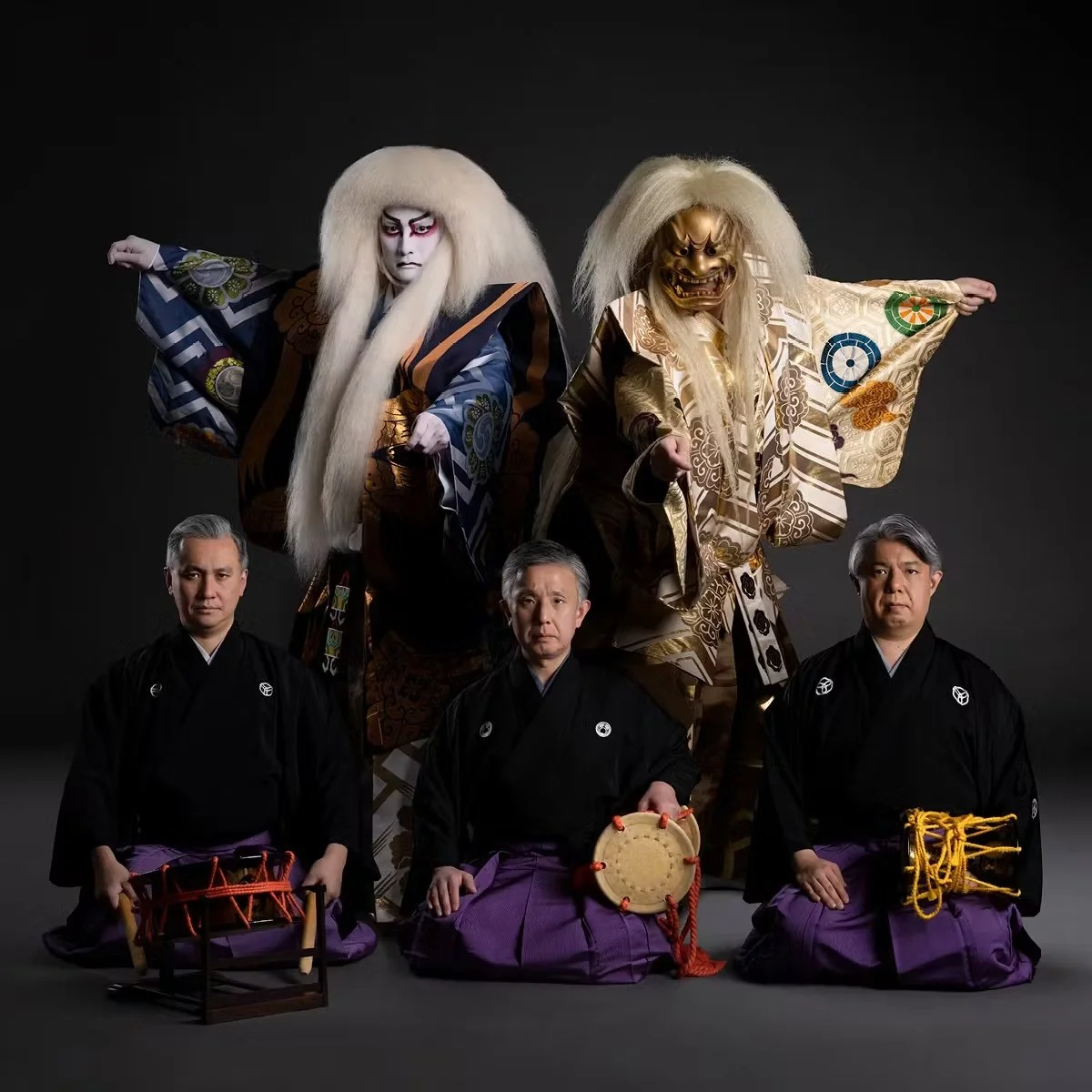
An Evening of Traditional Japanese Arts by Kosuke Yoshino
Sankyokai
Sankyokai (“Three Resonances”) is an ensemble dedicated to exploring new artistic possibilities through the sound of hayashi—the traditional musical accompaniment of Noh and Kabuki—by fusing the resonances of Japan’s two foremost traditional performing arts. Since its founding in 1997, the group has carried forward the spirit of classical performance while continuing to create sounds that transcend time.
The members are three brothers: Hirotada Kamei, head of the Kadono School of Noh Otsuzumi (large hand drum); Denzaemon Tanaka XIII, head of the Tanaka School of Kabuki music; and Denjiro Tanaka VII, also a Kabuki musician of the Tanaka School.
Their father, Tadao Kamei, was a Living National Treasure in Japan and head of the Kadono School of Noh drumming who performed at Carnegie Hall in 2016; their mother, Sataro Tanaka IX, was the head of the Tanaka School of Kabuki music. Born to parents who represented these two distinct classical traditions, the brothers literally embody the meeting point of Noh and Kabuki.
From early childhood, they grew up exploring boundaries seamlessly between the two worlds—Noh, with its 600-year-old spiritual rigor; and Kabuki, born 200 years later with its vivid theatricality. As they matured, each pursued his own professional path: the eldest, Hirotada, in Noh; the middle brother, Denzaemon, and the youngest, Denjiro, in Kabuki. Yet through years of training, they began to sense a shared desire: to discover a form of expression that could transition between these traditions without breaking their structure or form.
Out of this belief, Sankyokai was born. Three Resonances reflects both the trio’s instruments—Hirotada’s Otsuzumi, Denzaemon’s Kotsuzumi, and Denjiro’s Taiko—and their wish to create a unified resonance born from their individual spirits. From its inception, Sankyokai has sought to present the timeless allure of classical performance in a contemporary context, finding new vitality in the dialogue and contrast between Noh and Kabuki. Today, the three brothers continue their journey as performers, creators, and stewards of Japan’s classical heritage, carrying it forward into the future.
Glossary of Terms
If you are new to traditional Japanese arts, you may not be familiar with the terms in this post. Please refer to the brief primer below to get you up to speed.
Kabuki: Classical Japanese theater that combines singing, acting, and dramatic poses and is known for elaborate costumes and makeup. Although men have performed all the roles since the mid-17th century, kabuki was established by a woman, Izumo no Okuni, around the year 1603. In 2008, UNESCO inscribed kabuki in the Representative List of the Intangible Cultural Heritage of Humanity.
Noh: Japan’s oldest major theatrical art form, which has been performed since the 14th century. Based on literary tales, noh’s themes revolve around regret and spiritual transformation. Actors use masks to emphasize emotion and props such as folding fans to enhance the story.
Shamisen: Three-stringed, banjo-like instrument with a long neck and a distinct twangy sound. As one of the instruments providing accompaniment for kabuki, the shamisen enhances dramatic scenes and sets the mood. Originating in China, the Ryukyu Kingdom (what is now Okinawa Prefecture) introduced the instrument to mainland Japan in the mid-16th century.
Wadaiko: The traditional art of Japanese drumming, encompassing drums of a variety of sizes played by a group. Accompanying both kabuki and noh, wadaiko provides rhythm and sound effects and helps to create dramatic tension.
Japanese Dance: Known as Nihon buyo, traditional Japanese dance grew out of kabuki in the 17th century. It is a style of visual storytelling that incorporates refined movements and precise gestures.
Koto: The national instrument of Japan. The koto is a zither made of Paulownia wood and typically has 13 silk strings. Originally associated with gagaku, or court music, the koto is not standard in kabuki or noh.
Shakuhachi: Vertically held Japanese bamboo flute. First introduced from China in the 8th century, the shakuhachi was a staple in gagaku (court) music and later became used in Zen Buddhist meditation.
Nagauta: Genre of traditional Japanese music that literally means “long song.” Developed around the year 1740, nagauta is performed on shamisen to accompany kabuki. It is a lyrical style of music, focused more on expression rather than storytelling.
Shinobue: Japanese transverse bamboo flute with a high-pitched sound. In addition to its important role in kabuki and noh ensembles, the shinobue is integral to Shinto rituals as well as festivals and folk music.
Support JapanCulture•NYC by becoming a member! For $5 a month, you’ll help maintain the high quality of our site while we continue to showcase and promote the activities of our vibrant community. Please click here to begin your membership today!